
Electrical Contractor License
An electrical contractor license is a business credential that authorizes a company to contract for electrical work, pull permits, and employ electricians — separate from the journeyman or master license held by the person doing the work. Most states issue it only when a qualifying individual, almost always a master electrician, is formally tied to the business, and the insurance, bonding, and fee obligations attach to the company rather than to that individual. National Building Permits prepares and files electrical contractor license applications nationwide, covering qualifier assignment, experience documentation, exam prep, insurance filings, and submission to the state board.
- 50-State Coverage
- Qualifier and Insurance Filings Handled
- Exam Prep Included
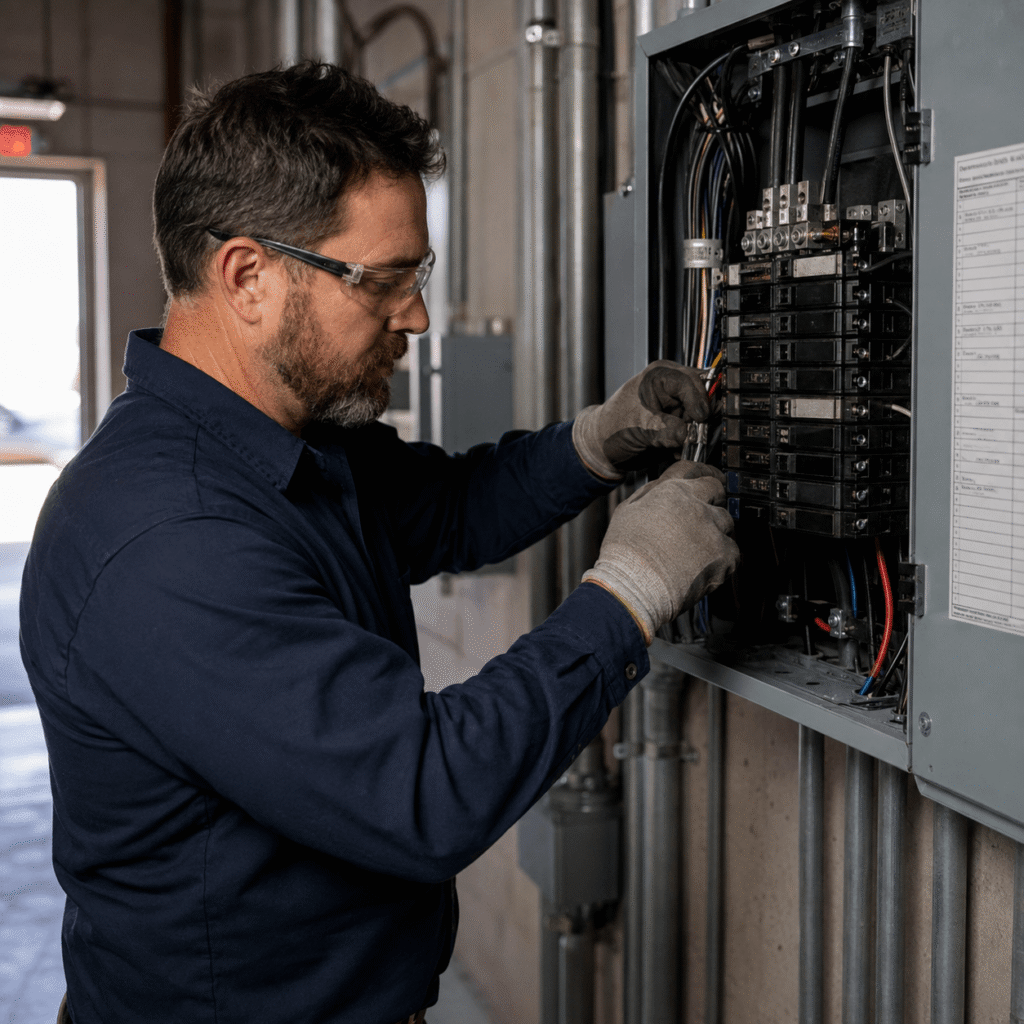
Why an Electrical Contractor License Is a Business Credential, Not a Trade Credential
Applications are most often filed incorrectly because the applicant treats the contractor license as the next rung on a personal career ladder. It is not. In most states the license belongs to the business entity, and a separately licensed individual is attached to it as the qualifying party carrying technical responsibility for the work. Passing a master electrician exam does not, by itself, license a company to contract.
Texas states the rule plainly. To apply for a Texas electrical contractor license, the business must employ a licensed master electrician, who may also be the owner. That master electrician may only be assigned to a single electrical contractor unless they own more than 50 percent of the business, and if the master electrician of record leaves, a replacement must be designated within thirty business days of the separation. A contractor license with no qualifier attached is not a functioning license.
The obligations differ for the same reason. Texas requires the electrical contractor to carry general liability coverage of at least $300,000 per occurrence combined for property damage and bodily injury, at least $600,000 aggregate, and at least $300,000 aggregate for products and completed operations. Those limits attach to the company; the master electrician’s own license carries no such requirement.
Source: Texas Department of Licensing and Regulation, Apply for a New Electrical Contractor License (accessed August 13, 2026).
How California, Florida, and Texas Each Define Electrical Contracting
The three largest construction markets in the country draw the boundary around electrical work in three different places. What one state treats as a single classification, another splits into a statewide credential and a local one.
California Licenses Electrical Contractors as the C-10 Classification Under the CSLB
California’s Contractors State License Board defines the C-10 Electrical classification in the California Code of Regulations, Title 16, Division 8, Article 3. A C-10 contractor places, installs, erects or connects electrical wires, fixtures, appliances, apparatus, raceways, conduits, solar photovoltaic cells, or any part of those systems that generates, transmits, transforms, or utilizes electrical energy in any form or for any purpose. The scope is written broadly on purpose: it is the line-voltage classification, and it covers photovoltaic work that other states hand to a separate solar trade.
California is also the one state here where the electrical credential is a specialty classification inside a broader contractor licensing system rather than a standalone electrical scheme. The C-10 sits alongside the CSLB’s other Class C specialties under the same application, exam, and bond framework that governs general building contractors.
Source: CSLB, C-10 Electrical, Licensing Classifications Detail (accessed August 13, 2026).
Florida Separates Certified Electrical Contractors From Registered Ones
Florida licenses electrical contractors through the Electrical Contractors’ Licensing Board under the Department of Business and Professional Regulation, and the distinction that matters is where you are allowed to work. A certified license is statewide. A registered license only allows work in the cities or counties where the holder has a competency card.
The scope difference goes further than geography. Florida’s certified classification, occupation code EC, covers installing, repairing, altering, adding to, or designing electrical wiring, fixtures, appliances, apparatus, raceways, and conduit, including systems within plants and substations and all alarm systems and specialty categories. The registered classification, ER, is limited to the jurisdictions of registration and may not contract for any alarm system at all. An electrical contractor who assumes alarm work travels with the registration will find it does not.
Florida also runs licenses on a fixed statewide cycle rather than a rolling anniversary date. Certified and registered electrical contractor licenses expire August 31 of every even-numbered year, and renewal requires completing continuing education first. Certified electrical contractors owe 11 hours per cycle, including a Florida Building Code advanced module course and six technical hours. DBPR administers the electrical examinations in computer-based format through Pearson VUE.
Source: Florida DBPR, Electrical Contractors, License Types and Renewal Requirements (accessed August 13, 2026).
Texas Licenses the Business Through TDLR and the Electrician Separately
Texas issues the electrical contractor license to the business entity through the Texas Department of Licensing and Regulation, the only credential in this comparison that is explicitly a business license with an individual attached. TDLR defines electrical contractors as licensed to engage in the business of designing, installing, erecting, repairing, or altering electrical wires or conductors used for light, heat, power, or signaling purposes, including the ducts, raceways, and conduits protecting them.
The application is filed by mail with a non-refundable $110 fee, sent to TDLR at PO Box 12157, Austin TX 78711-2157. Texas electrician licenses are valid for one year from issuance and must be renewed annually, with renewals available online. Workers’ compensation handling is unusual: applicants submit proof of coverage, a certificate of authority to self-insure, or a statement electing not to obtain coverage under Subchapter A, Chapter 406 of the Labor Code, and an employer that so elects must file an online notice of no coverage with the Texas Department of Insurance.
Source: Texas Department of Licensing and Regulation, Apply for a New Electrical Contractor License (accessed August 13, 2026).
What Low Voltage Licensing Covers and Exactly Where It Stops
A low voltage contractor license authorizes energy-limited communication and signaling work, and most states write a hard voltage ceiling into the classification. California sets it at 91 volts. The CSLB’s C-7 Low Voltage Systems classification covers communication and low voltage systems that are energy limited and do not exceed 91 volts, including telephone, sound, cable television, closed-circuit video, satellite dish antennas, instrumentation and temperature controls, and low voltage landscape lighting.
The exclusion is the part that catches people. California’s C-7 classification specifically does not include low voltage fire alarm systems. A contractor who holds a C-7 and assumes fire alarm work falls under the same energy-limited umbrella is working outside the classification.
Florida structures the same work differently. Rather than a dedicated low voltage classification, it issues specialty electrical contractor licenses limited to a defined segment of electrical or alarm contracting, and low voltage system specialist is one of those segments, carried under class code 069. Those specialty licenses come in both certified and registered forms, with the same statewide-versus-local distinction that applies to full electrical contractors.
The practical rule in both states is the same: a low voltage electrical license does not scale up. The moment work crosses into line voltage, the full electrical contractor classification applies.
Source: CSLB, C-7 Low Voltage Systems Contractor, Licensing Classifications Detail (accessed August 13, 2026). Florida DBPR, Electrical Contractors, License Types (accessed August 13, 2026).
What a Reciprocal Electrical License Actually Transfers Between States
Reciprocity covers individual electrician credentials, not contractor licenses, and it is narrower than most applicants expect. Texas is the clearest published example. As of August 13, 2026, TDLR’s out-of-state transfer page lists master electrician reciprocity with Arkansas, Louisiana, Nebraska, and North Carolina, and journeyman reciprocity with Alaska, Arkansas, Idaho, Iowa, Montana, Nebraska, New Mexico, Oklahoma, South Dakota, and Wyoming. For every other license type it states there are currently no reciprocal agreements at all — which includes the electrical contractor license itself.
A listed state is not automatic either. A master electrician applying to Texas by reciprocity must have passed the reciprocating state’s statewide examination, held that license at least one year, accumulated at least 12,000 hours under a master electrician’s supervision, and held a journeyman license at least two years. Louisiana carries an extra condition: Texas requires the applicant to be a Louisiana resident to qualify on that basis.
One caution worth stating plainly, because it affects anyone planning a move on the strength of a headline. TDLR announced additional electrician reciprocity agreements by press release during 2026, including Iowa in February, Alabama in March, and Ohio in June. As of the date this page was verified, those announcements were not all reflected on TDLR’s out-of-state transfer page. The transfer page is the operative list for filing; confirm current status with the department before relying on an agreement announced elsewhere.
Source: Texas Department of Licensing and Regulation, Transfer Your Out-of-State Electrician License to Texas (accessed August 13, 2026). TDLR News and Updates, electrician reciprocity announcements (accessed August 13, 2026).
Electrical Contractor Licensing Authority by State
Every state regulates electrical contracting differently — some issue a single license valid anywhere in the state, some cap that license below a certain project size, and a few leave the business-level credential to individual electricians or to cities and counties. Find your state below to see which applies.
| State | Licensing Authority | License Type | Source |
|---|---|---|---|
| Alabama | Alabama Board of Electrical Contractors | Statewide certified | §34-36-13 |
| Alaska | Dept. of Commerce, Community & Economic Development (contractor registration) / Dept. of Labor & Workforce Development (electrician licensing) | Statewide certified | AS 08.40 / AS 08.18 |
| Arizona | Arizona Registrar of Contractors | Statewide certified (C-11/CR-11/R-11) | roc.az.gov |
| Arkansas | Arkansas Contractors Licensing Board (business, projects ≥$50,000) + Board of Electrical Examiners (individual) | Statewide certified, threshold-gated | Ark. Admin. Code 033.00.11-002 |
| California | Contractors State License Board | Statewide certified (C-10) | Cal. Code Regs. tit. 16, div. 8, art. 3 |
| Colorado | Colorado State Electrical Board (DORA) | Statewide certified | dpo.colorado.gov |
| Connecticut | Dept. of Consumer Protection, Electrical Licensing | No state-level contractor license — individuals only | portal.ct.gov |
| Delaware | Board of Electrical Examiners | No state-level contractor license — individuals only | dpr.delaware.gov |
| Florida | DBPR Electrical Contractors’ Licensing Board | Statewide certified (Certified tier) or registered-local only (Registered tier) | myfloridalicense.com |
| Georgia | Georgia State Board of Electrical Contractors | Statewide certified | sos.ga.gov, Rule 121-2-.01 |
| Hawaii | Contractors License Board | Statewide certified (C-13) | cca.hawaii.gov |
| Idaho | Idaho Electrical Board (DOPL) | Statewide certified | Idaho Code Title 54, Ch. 10 |
| Illinois | No state agency — municipal registration only | No state-level license | 65 ILCS 5/11-33-1 |
| Indiana | No state agency — municipal licensing only | No state-level license | in.gov/pla (electrical not on state’s licensed-professions list) |
| Iowa | Electrical Examining Board | Statewide certified | Iowa Code Ch. 103 |
| Kansas | No statewide agency — municipal only (statewide program enacted, effective July 1, 2027) | No state-level license (current) | K.S.A. 12-1527 |
| Kentucky | Dept. of Housing, Buildings and Construction | Statewide certified | 815 KAR 35:060 |
| Louisiana | Louisiana State Licensing Board for Contractors | Statewide certified, threshold-gated (over $10,000) | lslbc.gov |
| Maine | Electricians’ Examining Board | No state-level contractor license — individuals only | maine.gov |
| Maryland | Maryland State Board of Electricians | Statewide certified | labor.maryland.gov |
| Massachusetts | Board of State Examiners of Electricians | Statewide certified | 237 CMR 16.03 |
| Michigan | Bureau of Construction Codes (LARA) | Statewide certified | MCL 339.5711/339.5737 |
| Minnesota | Dept. of Labor and Industry | Statewide certified | dli.mn.gov |
| Mississippi† | Mississippi State Board of Contractors | Statewide certified, threshold-gated (at or above $50,000) | Miss. Code Ann. §31-3-13 |
| Missouri | Office of Statewide Electrical Contractors | Statewide certified (optional — local licenses also accepted) | RSMo §324.920/.925 |
| Montana | Montana State Electrical Board | Statewide certified | boards.bsd.dli.mt.gov |
| Nebraska | Nebraska State Electrical Division | Statewide certified | Nebraska State Electrical Act |
| Nevada† | Nevada State Contractors Board | Statewide certified (C-2) | NAC 624.200 |
| New Hampshire | Electricians’ Board (OPLC) | Statewide certified | RSA 319-C:10 |
| New Jersey | Board of Examiners of Electrical Contractors | Statewide certified | njconsumeraffairs.gov/elec |
| New Mexico | Construction Industries Division | Statewide certified (EE-98) | 14.6.6 NMAC |
| New York | No statewide agency — municipal only (NYC DOB and others) | No state-level license | (no statewide electrical contractor credential exists) |
| North Carolina† | NC State Board of Examiners of Electrical Contractors | Statewide certified | G.S. 87-43 |
| North Dakota† | North Dakota State Electrical Board | Statewide certified | NDCC Ch. 43-09 |
| Ohio | Ohio Construction Industry Licensing Board | Statewide certified for commercial work; residential may also require local licensing | ORC 4740 |
| Oklahoma | Construction Industries Board | Statewide certified | oklahoma.gov/cib |
| Oregon | Building Codes Division + Construction Contractors Board | Statewide certified (dual credential required) | oregon.gov/bcd |
| Pennsylvania | No statewide agency | No state-level license | pa.gov/dli (“no licensure or certification requirements for most construction contractors”) |
| Rhode Island | Board of Examiners of Electricians | Statewide certified | R.I. Gen. Laws §5-6-8 |
| South Carolina | SC Contractor’s Licensing Board (Electrical classification) | Statewide certified, threshold-gated (over $10,000) | llr.sc.gov |
| South Dakota | South Dakota Electrical Commission | Statewide certified | SDCL 36-16-1 |
| Tennessee | TN Board for Licensing Contractors (CE classification) | Statewide certified, threshold-gated ($25,000 or more) | tn.gov/commerce/regboards/contractors |
| Texas | Texas Department of Licensing and Regulation | Statewide certified | tdlr.texas.gov |
| Utah | Division of Professional Licensing (DOPL) | Statewide certified (S200/S201) | Utah Code Title 58, Ch. 55 |
| Vermont | Electricians’ Licensing Board | No state-level contractor license — individuals only | 26 V.S.A. Ch. 15, §§901–910 |
| Virginia | DPOR Board for Contractors | Statewide certified | dpor.virginia.gov |
| Washington | Dept. of Labor & Industries, Electrical Program | Statewide certified | RCW 19.28 |
| West Virginia | Office of the State Fire Marshal | Statewide certified | W. Va. Code §29-3B-2 |
| Wisconsin | Dept. of Safety and Professional Services | Statewide certified | Wis. Admin. Code SPS 305.41 |
| Wyoming | Dept. of Fire Prevention and Electrical Safety | Statewide certified | Wyo. Stat. §35-9-125 |
North Carolina, North Dakota, Mississippi, and Nevada’s electrical licensing boards operate on non-.gov domains. Each is confirmed as the genuine state-created regulatory board — not a private or commercial site — via its own published statute, classification list, or board rules.
How We File Your Electrical Contractor License Application
Confirm Which Credential Your Work Actually Requires
We match the work you intend to perform against the classification that authorizes it in your state, full electrical contractor or low voltage specialty, before any form is filled. This is where most misfiled applications are prevented.
Assign and Document the Qualifying Individual
We identify who will serve as the qualifying master electrician, confirm they are eligible to be assigned, and assemble the experience documentation the board requires.
Prepare Insurance, Bonding, and Exam Requirements
We compile the insurance, workers’ compensation, and bonding documentation your state requires in the exact form the board accepts, and prepare your qualifier for the exams that apply.
File With the Board and Track It Through Issuance
We submit to the state board, respond to deficiency notices on your behalf, and track the file to issuance so you are not discovering a missing document weeks later.
Why Work With National Building Permits on an Electrical License
All 50 States
We file electrical contractor and specialty electrical applications in every state, including states that license at municipal level rather than statewide.
Qualifier Assignment Handled
We manage the master electrician assignment, including the documentation boards require to accept it and the notice requirements when a qualifier changes.
Insurance and Bonding Filings
We prepare the certificate of insurance, workers’ compensation documentation, and bond filings in the form each board accepts, which is where files most often stall.
Exam Prep Included
We prepare your qualifier for the trade and law-and-business examinations their state requires, including the reference materials the board publishes.
Complete, First-Pass Filings
We submit complete files rather than partial ones, the single largest factor in how long a board takes to act.
Permit and Licensing Services That Work Alongside an Electrical License
An electrical contractor license authorizes you to contract and pull permits, but it does not move the permits themselves. Contractors who file with us for a license frequently use our permit expediting services on the same projects, particularly on commercial work where electrical permits are reviewed alongside structural and mechanical scopes.
If your business also contracts beyond the electrical trade, the general contractor license is a separate credential with its own experience, exam, and bonding requirements, held in addition to the electrical classification rather than instead of it. In Florida, both sit under the same certified and registered structure covered on our Florida contractor licensing page. In California, the C-10 sits inside the CSLB system alongside the permit review we handle for Los Angeles permit applicants.
Common Questions About Electrical Contractor Licensing
Requirements are set by each state and generally combine four elements: a qualifying individual with a master or equivalent electrician license attached to the business, documented trade experience, one or more examinations, and proof of insurance or bonding. Texas requires an electrical contractor to employ a licensed master electrician and to carry general liability coverage of at least $300,000 per occurrence, $600,000 aggregate, and $300,000 aggregate for products and completed operations. California instead issues the C-10 Electrical classification through the Contractors State License Board as one specialty within its broader contractor licensing system.
Holding a journeyman or master electrician license is a prerequisite in most states, not the finish line. To obtain an electrician license at contractor level, the individual credential is attached to a business entity, and the business files its own application. In Texas, the master electrician may be the business owner, but that master electrician may only be assigned to a single electrical contractor unless they own more than 50 percent of the business. In Florida, the path runs through the Electrical Contractors’ Licensing Board as either a certified or a registered license.
A low voltage license is capped by voltage and by system type; a full electrical contractor license is not. California’s C-7 Low Voltage Systems classification covers communication and low voltage systems that are energy limited and do not exceed 91 volts, including telephone, sound, cable television, closed-circuit video, satellite dish antennas, instrumentation and temperature controls, and low voltage landscape lighting, and it specifically excludes low voltage fire alarm systems. Florida handles the same scope as a specialty electrical contractor license, with low voltage system specialist carried under class code 069.
Contractor licenses generally do not transfer; individual electrician licenses sometimes do. As of August 13, 2026, the Texas Department of Licensing and Regulation published master electrician reciprocity with Arkansas, Louisiana, Nebraska, and North Carolina, and journeyman reciprocity with Alaska, Arkansas, Idaho, Iowa, Montana, Nebraska, New Mexico, Oklahoma, South Dakota, and Wyoming, and stated that no reciprocal agreements exist for any other license type. A master electrician transferring to Texas must also have held the reciprocal license for at least one year and documented at least 12,000 hours under a master electrician.
Examination content and the meaning of certification both vary by state. Florida uses the term specifically: a certified electrical contractor holds a statewide license, while a registered electrical contractor may only contract in the cities or counties where the registration was issued. Florida administers its electrical examinations in computer-based format through Pearson VUE. Certified electrical contractors in Florida also owe 11 hours of continuing education each renewal cycle, including a Florida Building Code advanced module course, and licenses expire August 31 of every even-numbered year.
We handle the application end to end: confirming which classification your intended work requires, assigning and documenting the qualifying master electrician, preparing insurance and bonding filings in the form the board accepts, preparing your qualifier for the required examinations, and submitting the completed file to the board. We also respond to deficiency notices and track the application through issuance. Call 855-212-2722 or request a quote and we will confirm exactly what your state requires before anything is filed.
Get My Quote
Tell us the state and the type of electrical work you intend to perform, and we will confirm exactly what your state requires before anything is filed — qualifier, insurance, exams, and fees included.